
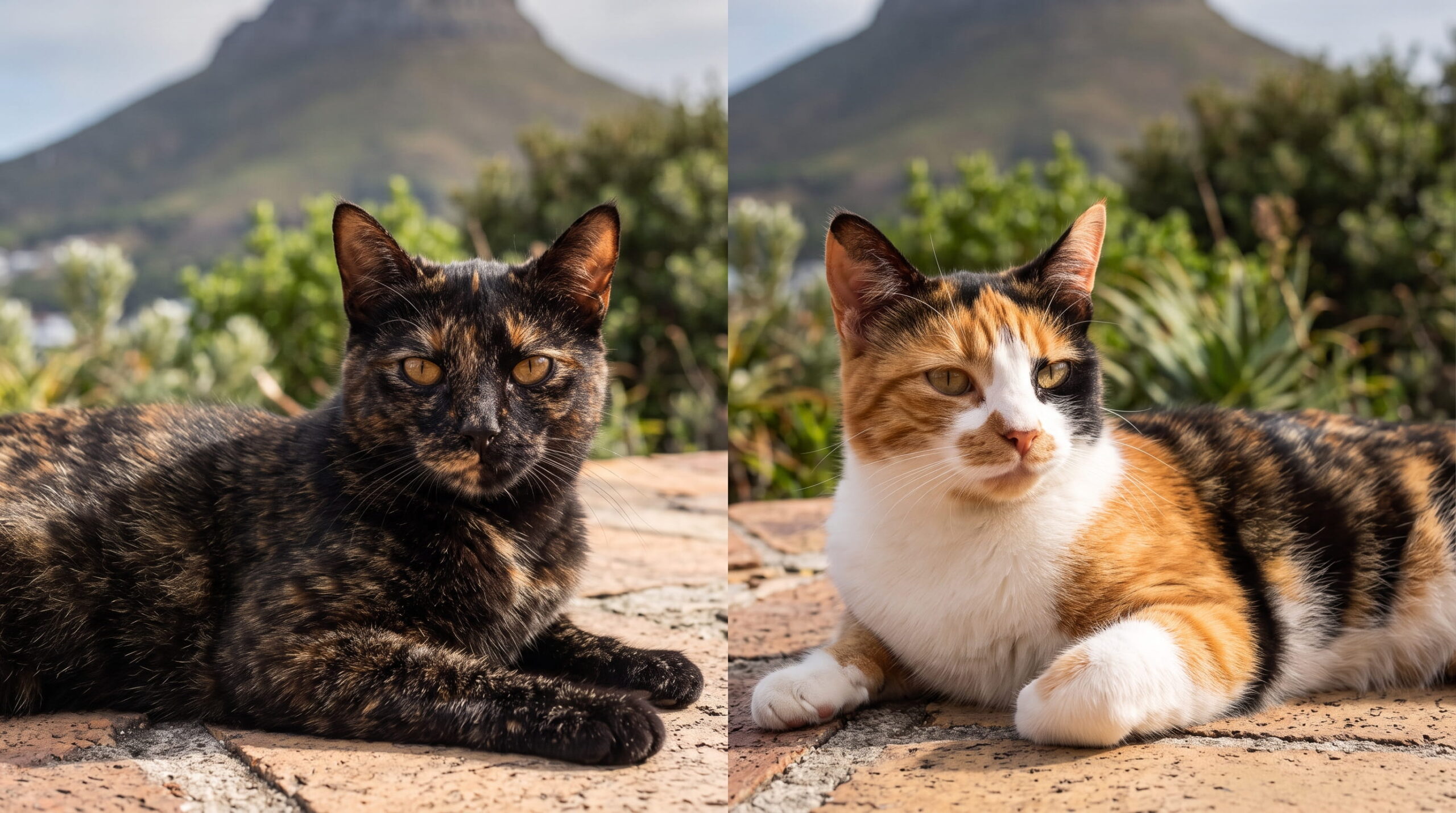
If you’ve ever found yourself staring at a beautifully speckled street cat in Bo-Kaap or a cute rescue kitten in Observatory, wondering, “Is that a tortoiseshell or a calico?”—you’re not alone! While these striking felines are often confused for one another, telling them apart is actually surprisingly simple once you know the golden rule.
Here is all you need to know about Tortoiseshells vs. Calicos.
The Golden Rule: Look for White
The easiest, fastest way to tell a Tortoiseshell apart from a Calico comes down to one single color: white.
- Tortoiseshell (Tortie): A Tortie’s coat is a blended mixture of black (or brown/grey) and red (or orange/cream). Their colors are flecked, mottled, or woven closely together—almost like a marble pattern or autumn leaves. Torties have almost no white fur (or only very tiny patches).
- Calico: Calicos have distinct, clearly defined patches of three distinct colors: white, black, and orange (or gray and cream in “dilute” calicos). White is usually the base color, taking up anywhere from 25% to 75% of their body.
Quick Cheat Sheet:
- Mottled colors + No white = Tortoiseshell
- Distinct patches + Lots of white = Calico
- Mottled coat + Large white belly/paws = Torbie or Caliby (a tortoise-shell/tabby mix with white!)
Is it a Breed?
Nope! Neither Tortoiseshell nor Calico is a cat breed. Both terms refer strictly to coat color patterns. You can find torties and calicos in many different breeds, including domestic shorthairs, Maine Coons, Persians, and British Shorthairs.
The Mind-Blowing Science: Why Almost All Are Female
Have you ever heard that all Torties and Calico cats are female? It’s almost 100% true!
It all comes down to genetics:
- The gene that determines orange vs. black coat color is carried on the X chromosome.
- Female cats have two X chromosomes (XX). One X carries the code for orange fur, while the other carries the code for black/brown fur. As the kitten develops, different cells randomly activate one X and turn off the other, creating the mottled or patched coat.
- Male cats have one X and one Y chromosome (XY). Since they only have one X, they can typically be orange OR black—not both.
Fun Fact: A male Tortie or Calico is extremely rare (roughly 1 in 3,000) and is usually the result of a genetic condition called Klinefelter Syndrome (where the male has XXY chromosomes).
The Myth of “Tortitude”
Ask any cat parent in Cape Town about their Tortie, and they’ll likely mention “Tortitude.”
Tortie owners often swear that tortoiseshell cats carry a feisty, sassy, independent, and fiercely loyal personality. While there is no definitive scientific proof that coat color dictates attitude, many cat parents around the world proudly wear the badge of serving a queen with Tortitude!