Trace the transformation of cats from wild mousers to cherished Victorian pets, and you’ll discover the rise of a unique street trade: the “cat’s meat men.” Kathryn Hughes dives into the world of these wandering offal sellers—examining their eerie connection to a Jack the Ripper victim and highlighting a grand feast thrown in their honor, presided over by famous cat artist Louis Wain.
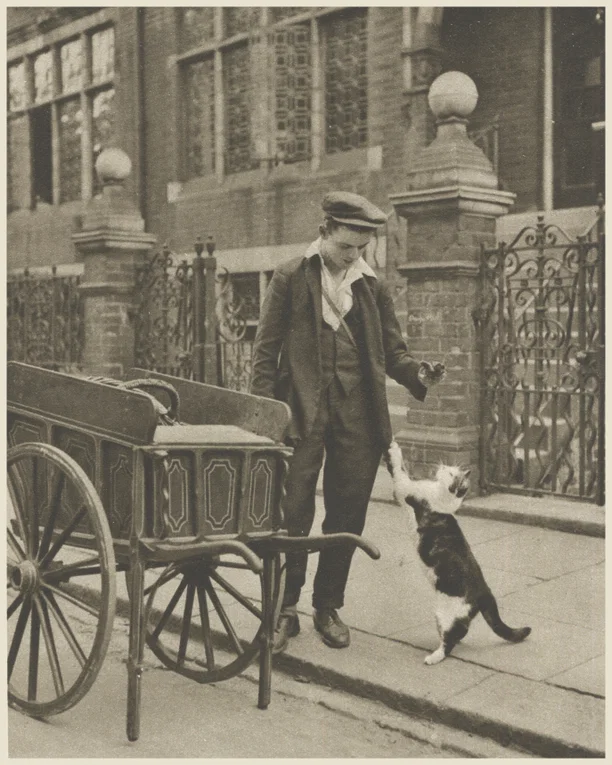
In her essay for The Public Domain Review, Kathryn Hughes paints a vivid portrait of Victorian London’s “cat’s meat men”—itinerant street vendors who hawked cheap horsemeat and offal for urban pets. Pushing barrows through neighborhood streets with loud cries of “CA-DOE-MEE!”, these vendors catered to a growing middle-class trend of buying dedicated food for domestic cats.
Though often viewed as rough-around-the-edges traders, many were surprisingly soft-hearted, routinely feeding the local stray cats that trailed their carts. Historical accounts, including Henry Mayhew’s famous 1851 survey, show that around 1,000 such hawkers roamed London, walking up to 40 miles a day. The trade served as a safety net for down-on-their-luck workers, broken carriage painters, and widows.
Yet, macabre associations constantly shadowed the trade. Victorian children (and anxious adults) regularly fretted over whether vendors were selling meat for cats or meat made of cats—a nightmare fueled by real-world reports of Parisians eating cats during the 1870–1871 Siege of Paris. The dark threshold between feline food and human flesh turned horrific in September 1888, when Jack the Ripper’s second victim, Annie Chapman, was found disemboweled on the back steps of 29 Hanbury Street—a house whose ground floor doubled as a cat’s meat shop run by seller Harriet Hardiman. The gruesome scene of exposed viscera right next to a horsemeat shop chilled the city to its core.
The supply chain behind the trade was equally gritty. As Charles Dickens documented in All the Year Round, abattoirs slaughtered elderly horses in the dead of night to satisfy London tabbies’ preference for fresh meat. By 6:00 AM, slaughterhouses delivered the meat to vendors, who spent an hour skewering it into halfpenny snacks before hitting the streets.
Despite the grueling work and grim reputation, the trade achieved a moment of high-society glory on January 10, 1901—just days before Queen Victoria’s death. Hosted by Our Cats magazine, 250 cat’s meat men dressed in their finest gear for a celebratory banquet at a Holborn restaurant. Guests cheered the roast beef with familiar street calls of “Mee-att!”, while the Duchess of Bedford helped pass around sprouts and urged the men to keep protecting stray cats. Feline illustrator Louis Wain—who chaired the evening—hailed the vendors not as subjects of charity, but as fellow “cat lovers and pals,” capping off a surreal celebration of one of London’s most iconic street trades.